Vaccine for Kidney Cancer
English
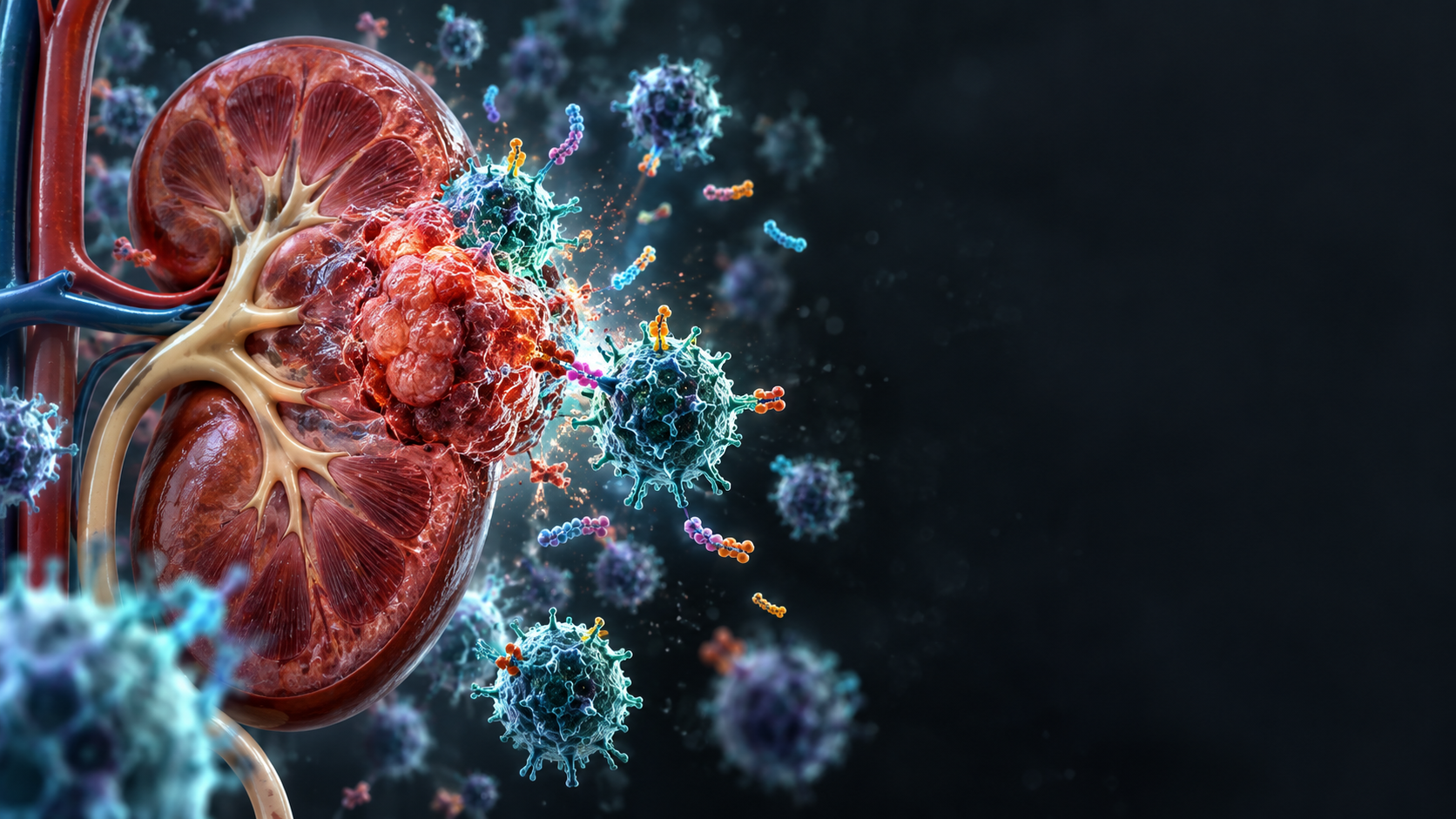
Scientific illustration of kidney cancer cells and an immune response

Personalised vaccines, immune treatment and precision medicine

Vaccine for
Kidney Cancer

A small first-in-human study has shown that personalised vaccines can teach immune cells to recognise clear-cell kidney cancer. The result is exciting, but vaccines remain experimental.

Current positionNo kidney-cancer vaccine is approved. Checkpoint immunotherapy is established treatment, but it is not a vaccine.
9 participantslandmark phase I vaccine study
Clear-cell RCCthe commonest kidney cancer
No approved vaccineaccess remains through research
Blood in urinealways deserves assessment

The evidence landscape

A remarkable early result, with important limits

Immune activation is encouraging. Only larger comparative trials can show whether a vaccine prevents recurrence or prolongs life.

Phase I human evidence

Personalised neoantigen vaccine after surgery

In a 2025 Nature report, nine people with high-risk, fully resected stage III or IV clear-cell renal cell carcinoma received a peptide vaccine designed from mutations in their own tumour, with or without ipilimumab.

All nine developed vaccine-directed T-cell responses. At a median 40.2 months after surgery, none had experienced recurrence, and no dose-limiting toxicity was reported.

Why this is not yet proofThere were only nine participants, no randomized control group, and only clear-cell tumours. The study was designed mainly to assess feasibility, safety and immune response, not to establish survival benefit.

Vaccine or immunotherapy?

Related strategies, but not the same treatment

Both recruit immunity. A vaccine supplies targets or instructions; checkpoint drugs release inhibitory brakes on existing immune cells.

01

Personalised vaccines

Neoantigen vaccines are made from an individual tumour's mutations. Peptide, RNA, DNA and dendritic-cell approaches are under investigation.

02

Checkpoint inhibitors

Pembrolizumab, nivolumab and other checkpoint drugs are established in selected kidney-cancer settings, often combined with another immune drug or a VEGF-targeted medicine.

Kidney immunotherapy guide
03

Oncolytic and cell vaccines

Modified viruses and tumour-cell products have been studied, but immune responses do not automatically translate into durable clinical benefit.

No guarantee: a treatment vaccine is given after cancer exists or has been removed. It aims to reduce recurrence or control disease; it cannot promise that cancer will never return.

Not one disease

Histology and genetics change the treatment path

“Kidney cancer” includes biologically distinct tumours. Evidence from clear-cell RCC should not be assumed to apply to every subtype.

Most common

Clear-cell RCC

Often driven by loss of VHL signalling and abnormal HIF/VEGF pathways. Most vaccine and checkpoint evidence is concentrated here.

Non-clear-cell

Papillary RCC

A separate family that can involve MET alterations and hereditary syndromes. Trial eligibility and targeted options differ.

Distinct biology

Chromophobe RCC

Usually less common and often more indolent when localised, although advanced disease still requires specialist management.

Rare aggressive types

Collecting duct, medullary and translocation

These require expert pathology and often have different systemic-treatment strategies. Renal medullary carcinoma is strongly associated with sickle-cell trait.

Separate diagnoses

Upper-tract urothelial and childhood cancers

Cancer of the renal pelvis is urothelial cancer, not RCC. Wilms tumour and other childhood kidney cancers also follow separate evidence.

Inherited risk can matter. Young age, bilateral or multiple tumours, unusual histology, or family history may prompt assessment for VHL, FH, FLCN, SDH, BAP1 and other hereditary syndromes.

Signs and diagnosis

Many kidney masses are found incidentally

Possible features include visible or microscopic blood in the urine, persistent flank pain, a mass, unexplained weight loss, fever, fatigue, anaemia or a new varicocele. These symptoms have many causes, but need proper assessment.

Never ignore haematuria

Visible blood, clots, difficulty passing urine, severe pain, fever or rapidly worsening illness warrant prompt medical care. A negative urine test cannot exclude kidney cancer.

Treatment context

Stage, subtype, kidney function and goals all matter

Decisions are best made by an experienced urological cancer team, with molecular review for uncommon or advanced disease.

Localised disease

Partial nephrectomy preserves kidney where feasible. Radical nephrectomy, ablation or active surveillance may be appropriate according to size, anatomy, health and growth.

After surgery

Surveillance is standard for many people. Adjuvant pembrolizumab is an option for selected high-risk clear-cell RCC; personalised vaccination remains a trial approach.

Advanced disease

Checkpoint combinations, VEGF-targeted drugs, HIF-2α inhibition, surgery, ablation and focused radiation are selected according to subtype, disease sites and prior treatment.

Clinical trials

Trials are the route to vaccine treatment

Ask whether the study is preventive after surgery or treating measurable disease, whether it accepts non-clear-cell histology, and what standard therapy it is compared with.

Connected guides

Evidence, immune treatment and new diagnostics

Research tools

Follow the evidence